Excitement as Special Needs Children Receive Assorted Assistive Devices
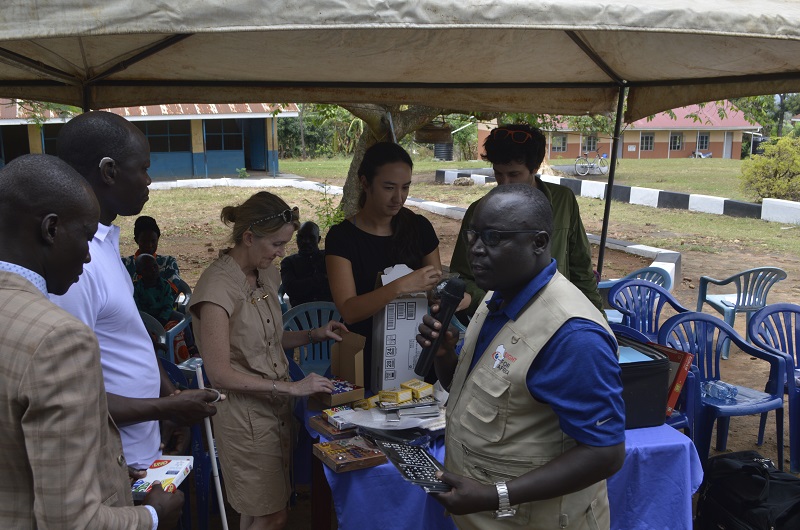
Robinson Afema (C) speaks after inspecting the assorted equipment. Photo Credit; Clement Aluma
ARUA CITY – There was excitement and relief at Arua Demonstration Primary School on Monday when visitors from the United States arrived to support the school’s special needs program.
The school has over 1,200 pupils, including about 50 children with special needs who have physical, visual, or hearing impairments.
Headteacher Jane Candiru highlighted the school’s challenges, noting a severe shortage of essential equipment.
“We had six Braille machines, but three have broken down, leaving the remaining ones overused and prone to further damage. We also have very few trained special needs teachers, which is far from enough,” Candiru said.
She added that the dormitories for special needs children are insufficient and the school compound is not disability-friendly, requiring redesign for better accessibility.
Suzanne K. Freitag, an Ophthalmic Plastic Surgeon and Director from Harvard Medical School, along with two colleagues, donated a range of assistive items. These included white canes, Braille alphabets, slate kits, Braille playing cards, ludo games, sanitary supplies, laundry items, and other materials to aid learning and daily living for visually impaired pupils.
Robinson Afema, CEO of Sight for Africa, emphasized the regional importance of the school.
“Uganda, and schools like Arua Demonstration, remain the only hope for many children with special needs from the Democratic Republic of Congo and South Sudan, as they have few other options,” Afema said.
The fate of visually impaired children in Uganda remains challenging, marked by high rates of educational exclusion, stigma, and limited access to specialized care—despite efforts by NGOs and other organizations to promote inclusion.
In Uganda and similar low-resource settings, many children with visual impairments face barriers to education due to a lack of trained teachers, Braille materials, and accessible infrastructure. While special schools like Arua Demonstration and Salama School for the Blind exist, many children in mainstream settings drop out because of inadequate support and high equipment costs.
Recent studies indicate that children with disabilities, including visual impairments, are significantly more likely to be out of school than their non-disabled peers in sub-Saharan Africa, with exclusion often linked to social attitudes, inaccessible environments, and resource shortages rather than the impairments alone.
Ayivu Division Mayor in Arua City, Marlon Avutia, criticized some parents in the region who believe children with visual challenges cannot succeed in life.
“The city will do everything possible to ensure children with disabilities can access education. However, we call on more partners to join and support this important cause,” Avutia said.
This donation brings hope and practical relief, helping bridge gaps in inclusive education and empowering these children toward greater independence and opportunity.