Why briquette business is not gaining traction
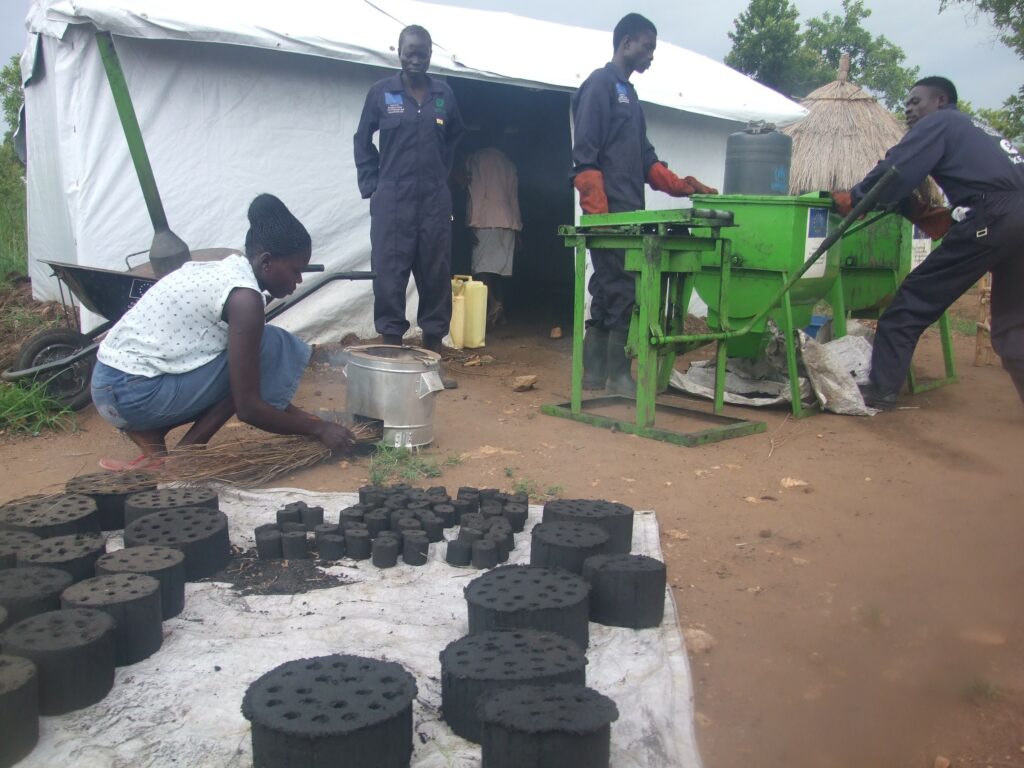
A group of youth making Briquettes at Imvepi settlement in Terego district. PHOTO BY FELIX WAROM OKELLO.
TEREGO/MADI-OKOLLO. Students and locals who have perfected the briquette making enterprise have revealed why their products meant to clean energy, alternative to charcoal use and protect the environment have failed to gain traction.
They say they are quickly forced to abandon or qualify it to factory grade due to lack of demand.
Mr Richard Asindu, who was sponsored by the Luigi Guisani Foundation at Inde technical college in renewable energy technology said even the institutions where they learn how to make the briquettes do not want to embrace their products.
“We have been training in Inde Technical Institute in briquette making but if communities around that institution would be given the opportunity to make the briquettes so that the institution uses it, the people would adopt it after seeing the economic viability,” he said on Monday.
He said the demand for the briquette would have gone up if institutions were the primary consumers.
Ms Angella Kiden, a South Sudan refugee earlier told this publication that she had been trained by other organizations on how to make briquettes and that people were not buying them.
“Many of us were trained to make briquettes as an alternative to charcoal but people don’t buy them when we take them to the markets. Few still believe that these things can work as charcoal. We have almost cut all our trees yet there is a need to protect the environment and briquettes would solve the problem of environmental destruction,” Kiden said.
The pricing
Briquettes, which are now an alternative source of energy, are sold between Shs 1000, 2000 to 5000 in most places in the West Nile sub-region.
This comes after a four year DANIDA funded initiative led by Oxfam Uganda in partnership with a consortium of 10 organizations which was aimed at enhancing resilience, peace and self-reliance among refugees and host communities in Yumbe, Madi-Okollo and Terego.
The Luigi Guissani Foundation provided the echo-friendly vocational training to in-school through and out of school youth capacity building promoting institutional greening.
The findings wanted to find out whether youth trained in vocational training institutions perform differently from those trained in the community. And why some youth groups thrive while others do not and how employers perceive the graduates.
Of the 504 certified youth targeted in the survey, 346 (172 females and 174 males) were successfully traced and surveyed representing a response rate of 69 per cent.
Why it is not gaining momentum
But while the youths rated the training positively, those who ventured into the enterprise of briquette making found it a challenge to proceed due to lack of market for their products while those in tree seedling production faced mixed challenges.
Mr Patrick Ejong, the Principle of Omugo skill development centre in Terego district said they are now working on their policies of environmental sustainability and climate actions in which they are embracing renewable energy and energy efficient technologies.
“At institutional level, we do not want to see waste, we have a lot of waste papers, waste wood from the carpentry so all these can help us to make the briquettes. We should be able to use them in our energy cookstoves and the ones we are using at the school are already powered by solar,” Ejong states.
Mr Rashid Kawawa, the Yumbe district Production Officer, advised all institutions to have woodlot and embrace mindset change in a way that people embrace green energy.
“We need to turn to alternative sources of energy because our environment is depleted heavily. We need to adapt to modern technologies,” he said.
A senior manager at Luigi Foundation, Mr Allen Onzima, revealed that the background to the project implemented since 2022 in the three districts all hosting refugees is that host communities which readily accept them often feel burdened by the sudden increase in population which creates pressure on available resources.
WHAT ARE BRIQUETTES?
Briquettes are a viable and low cost alternative to environmentally damaging fuels such as firewood, kerosene and charcoal. They are similar in appearance to regular charcoal but they are made out of charcoal waste, agricultural residues or sawdust, which are normally considered unusable waste.
Why Briquettes. The case for promoting a widespread use of briquettes is because the current use of charcoal and firewood is contributing to wide-scale deforestation in many developing countries. The cost of charcoal is also increasing. For instance, a sack of charcoal now costs between Shs 40,000 to Shs 65,000 across the West Nile sub-region.