How the EU-Funded SUIDAC Project is Transforming Lives in Arua City
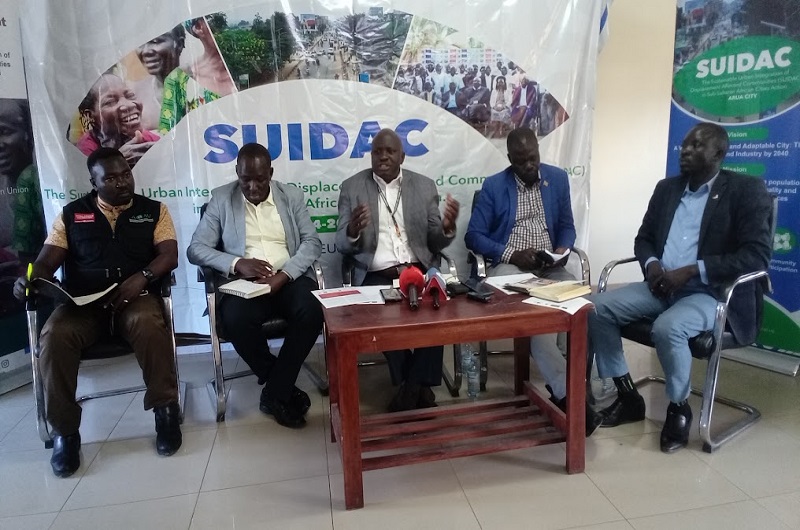
David Kyasanku (C) speaking during the SUIDAC press conference on Thursday. Photo Credit; Andrew Cohen Amvesi
ARUA CITY – With a daytime population of 440,540 people, Arua City has successfully integrated an additional 23,817 urban refugees into its systems.
“At the beginning, we didn’t understand how to deal with urban refugees or how to work with them. But when we joined the Sustainable Urban Integration of Displacement-Affected Communities (SUIDAC) project and received the training, we can now confidently say that refugees are fully integrated into our city systems,” said David Kyasanku, the Arua City Clerk.
He added: “We are now seeing refugees in schools, in our health centres, in school management committees, in health management committees, and in many other committees that run Arua City. We have even supported Community-Based Organizations (CBOs) that integrate host and refugee-led communities to implement joint programs.
“I think we really need to thank the European Union, Cities Alliance, and ACAV for the SUIDAC project, which has been a great success for us.”
Kyasanku made the remarks during a press conference on the progress of the SUIDAC project held at Arua City Hall on Thursday, April 23, 2026.
In Uganda, the EU-funded SUIDAC project is being implemented in Arua City and Koboko Municipality. Under the project, Arua City is set to implement programs worth USD 1.074 million, while Koboko Municipality will utilize USD 1.3 million.
ACAV has been tasked with providing technical assistance to both local governments to ensure the project is implemented in line with project management guidelines, donor requirements, national policies, and relevant laws.
Barely one year into implementation, Kyasanku told journalists that tangible results are already visible on the ground.
“I want to inform you that Arua City received the first tranche of USD 180,000 (about Shs600 million), and this funding will be disbursed in five tranches. So, this project is not only about capacity building,” he said.
In the first phase, Arua City is remodeling a science laboratory at Arua Public Secondary School, which has over 3,000 students and is one of the most populated schools in Northern Uganda.
The city is also constructing a general ward at Adumi Health Centre IV at a cost of Shs924 million. Adumi Health Centre serves a high number of expectant mothers from both refugee and host communities, but the existing ward has become too small.
Additionally, a satellite market with a shed, stalls, and a five-stance public toilet will be constructed in Dadamu at Shs49 million. The facility will benefit both refugees and host communities by improving their trading opportunities.
Arua City is further constructing a storage eight-classroom block at Arua Primary School at a cost of Shs749 million to ease severe overcrowding. “If you go there today, you will find seven pupils squeezed on a desk meant for three. It is simply unbearable,” Kyasanku explained.
He emphasized that the SUIDAC project goes beyond capacity building and software interventions. “Tangible funds have been sunk into critical infrastructure projects to help Arua City move forward,” he said.
Moses Acole, the Project Manager and Head of Programs at ACAV, revealed that through their technical works component, they are constructing a four-classroom block with a five-stance latrine each at Ociba Primary School and Onduparaka Primary School.
He urged the public to actively participate in monitoring the implementation of SUIDAC projects to ensure quality and accountability.
Patrick Bongo Namisi, the Cities Alliance Project Management Support Senior Officer for West Nile, explained that the SUIDAC program is an EU-funded initiative that began in 2024 and will run until 2028. Cities Alliance is responsible for the indirect management of the overall 30 million Euro program.
The program is being implemented in nine secondary cities and municipalities across five Sub-Saharan African countries: the Democratic Republic of Congo, Ethiopia, Somalia, Sudan, and Uganda (where Arua City and Koboko Municipality are the beneficiaries).
“The SUIDAC program is a city-led inclusive urban response to displacement. It focuses on strengthening city and municipal capacities in service delivery, livelihoods protection, urban governance, and planning, while also fostering city-to-city peer learning and engagement at national and regional levels through dialogues on migration and displacement,” Bongo said.
He thanked the European Union for its generosity and noted that six technical implementing partners are involved across the five countries, with ACAV serving as the partner in Uganda.
Poly Ongom, Assistant Resident City Commissioner (RCC) for Arua City in charge of Ayivu Division, expressed confidence in the Arua City authority’s technical capacity to implement the project successfully.
However, he requested that contractors assigned to SUIDAC projects be invited to future stakeholder meetings so they can receive vital information directly.
Ongom added that the Government of Uganda has created a peaceful and conducive environment, which is why foreign donors continue to entrust the country with their funds.